
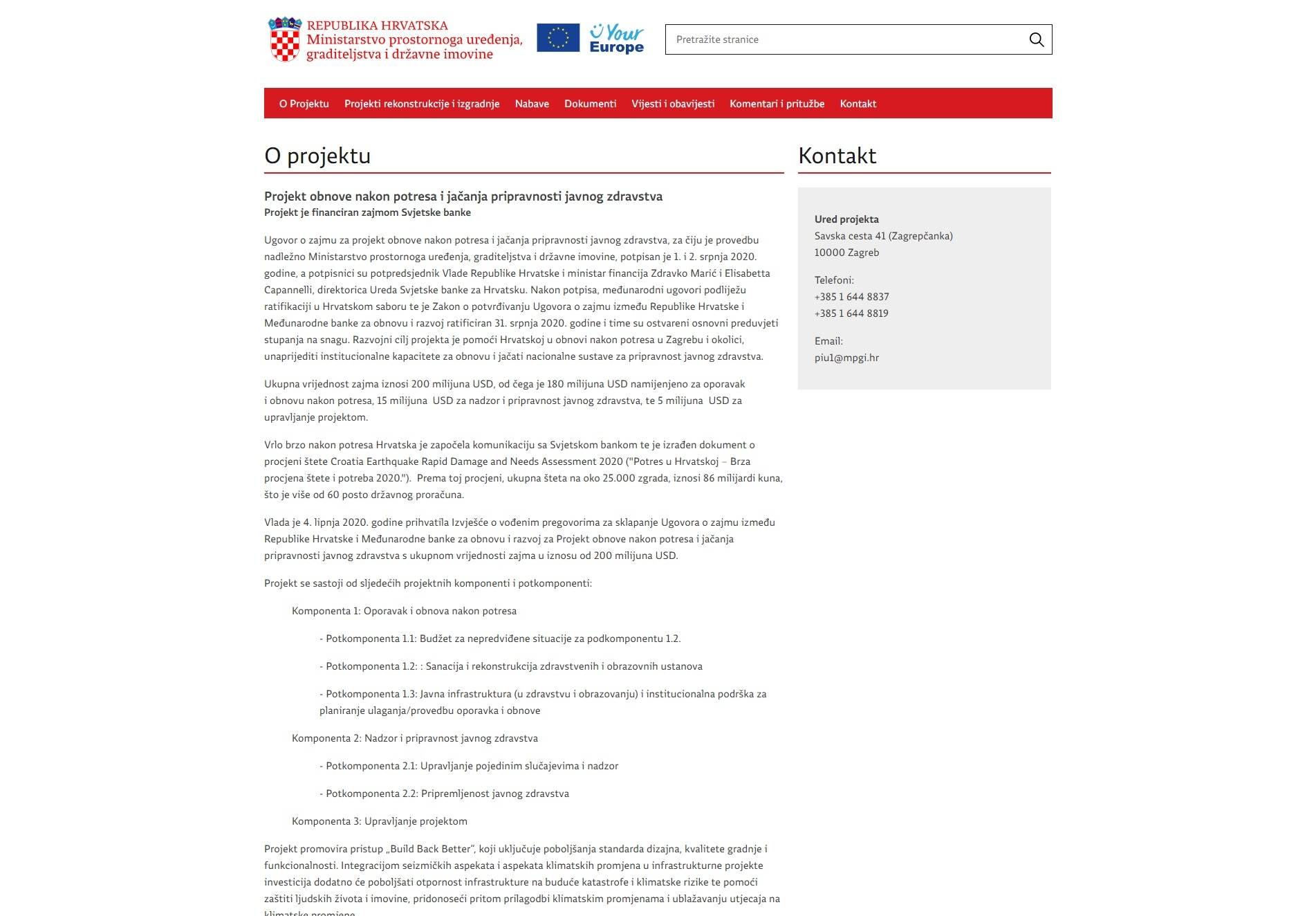
Project Recovery and Preparedness Web Portal
For the Ministry of Physical Planning, Construction and State Assets, we developed a web portal for the post-earthquake recovery project and the strengthening of public health preparedness.
This is a project of national importance, launched after the 2020 earthquake that struck Zagreb and its surroundings. The project is financed by a World Bank loan totaling USD 200 million, with the aim of helping Croatia restore damaged infrastructure, enhance institutional capacities for recovery, and strengthen national public health preparedness systems.
The web portal was developed as a central hub to present the project, track individual subprojects, publish documentation, and inform citizens, the professional public, potential bidders, and other involved stakeholders.
The central hub of a complex national project
One of the main challenges was the large volume of interrelated information that needed to be organized into a clear and comprehensible whole.
The project encompasses earthquake recovery and reconstruction, remediation and construction of healthcare, educational, and other public buildings, public health surveillance and preparedness, as well as overall project management.
The portal’s information architecture is designed so that different user groups can quickly find the content they need. Basic information about the project is separated from overviews of individual construction works, documentation, procurement, news, and contacts.
In this way, an extensive and technically demanding project is presented in a manner that is understandable even to users not directly involved in its implementation.
Overview of reconstruction and construction projects
A dedicated section of the portal is focused on individual reconstruction, recovery, and construction projects. Among the featured projects are University Hospital Centre Zagreb – Rebro Phase III, the Department of Pediatric Hematology and Oncology of UHC Zagreb, the Secondary Vocational School in Petrinja, the Croatian Institute of Public Health building on Nazorova Street, the Student Dormitory in Petrinja, and the reconstruction and extension of the FER building.
For each subproject, it is possible to publish a detailed description of the current state, planned construction works, the purpose of the facility, and the expected results. The content is accompanied by photos, visualizations, technical information, and related project documentation.
This structure allows each project to be presented as a standalone unit while maintaining a clear connection to the overall recovery and preparedness program.
“Build Back Better” approach
The project promotes the “Build Back Better” approach, which means reconstruction that does not merely return buildings to their pre-earthquake condition.
The goal is to improve design standards, construction quality, and the functionality of facilities, as well as increase their resilience to future earthquakes, climate risks, and other crisis situations.
The web portal provides a space to clearly present these goals and explain the broader social value of individual investments. This gives users fuller context for the restoration of healthcare, educational, and public facilities, not just information about the execution of construction works.
Extensive project documentation
An important part of the portal is a well-organized document archive. It includes environmental and social risk management plans, stakeholder engagement reports, studies, presentations, minutes from public briefings, and other documents required by World Bank rules and procedures.
The documentation is organized by individual subprojects, making it easier to find materials related to a specific institution or construction activity.
In this way, the portal plays an important role in ensuring transparency in project implementation. It provides citizens, institutions, and the interested professional public with access to documents on the environmental and social impact of works, planned protection measures, and the results of public consultations.
Procurement notices
A separate section is dedicated to procurement procedures related to the project and its subprojects.
In one place, the portal publishes calls for expressions of interest and bid submissions, project briefs, tender documentation, clarifications and amendments, contract award notices, and other related documents.
Given the volume and varied formats of the documentation, it was important to enable clear grouping of notices by institution and procurement procedure. This organization makes it easier to monitor ongoing procedures and find all their accompanying documentation.
News, notices, and public communication
The portal enables regular publication of news, notices, public presentations, and other activities related to project implementation.
Special attention is paid to communication with citizens and stakeholders. Users have access to contacts for the Project Office and individual subprojects, as well as information on how to submit comments, suggestions, and complaints.
Thus, the web portal is not just a one-way information outlet but also an important communication channel between the project holder, the institutions involved in the recovery, and the interested public.
Easy management via Globaladmin
The large volume of content, documents, procurements, and subproject information requires a system that allows editors to manage daily operations easily and securely.
The portal is integrated with our Globaladmin system, through which authorized editors can publish news, edit pages, add projects, organize documents, and update information on procurement procedures.
The modular structure allows further expansion of content and the addition of new subprojects without the need to change the portal’s core architecture.
Transparent digital support for recovery
The Recovery and Preparedness web portal combines a presentation website, a documentation system, and a communication platform for a complex project of national importance.
A clear content structure, detailed presentation of subprojects, an extensive document archive, and systematic publication of procurement procedures enable more transparent monitoring of recovery and easier access to information.
The project demonstrates how a well-designed digital solution can support the implementation of large infrastructure and public health programs and connect state institutions, professional stakeholders, and citizens on a single platform.